
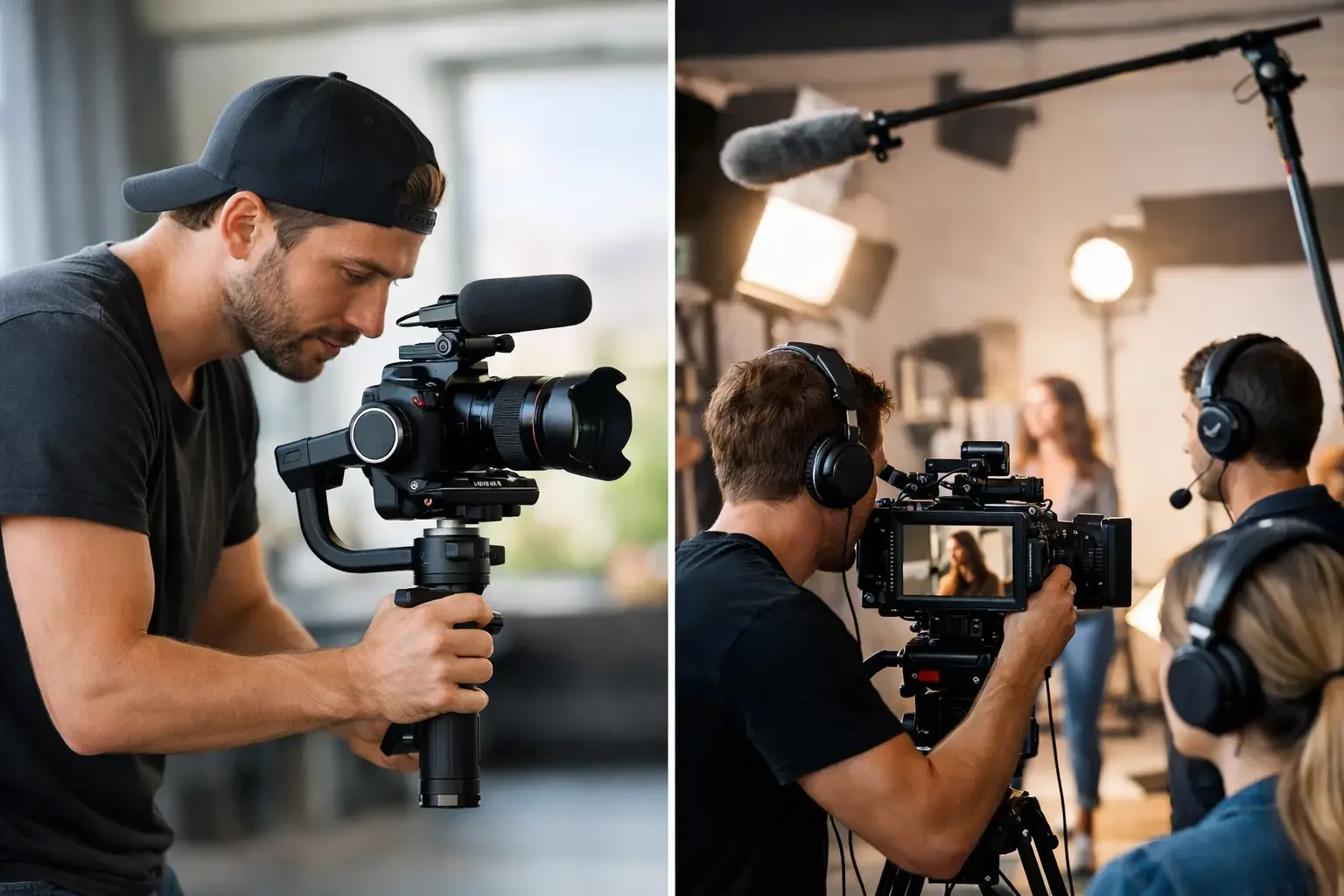
Videographer vs Video Production Company

If you are weighing a videographer vs video production company, the real question is not which option is better in general. It is which option will help your business communicate clearly, look credible, and produce a video that actually supports your marketing goals.

That distinction matters more than many companies realize. A lot of business leaders start with budget alone, then discover later that the cheapest path created extra revisions, unclear messaging, or a final video that looked fine but did not move the needle. At Chisum Multimedia, we believe the right choice depends on what you need the video to do, how much strategy is involved, and how much support you want before, during, and after production.

Videographer vs video production company: what is the difference?

A videographer is usually an individual professional or a very small crew focused primarily on capturing footage. In many cases, that person may also handle editing, audio, lighting, and delivery. For straightforward projects, that can work well.

A video production company typically brings a broader process. That often includes discovery, creative planning, scripting support, production management, directing, filming, editing, graphics, sound design, and guidance on how the final piece fits into your brand and marketing efforts.

The simplest way to think about it is this: a videographer is often a skilled technician and visual storyteller, while a production company is a structured creative partner built to manage larger business outcomes.

That does not mean one is automatically superior. It means they solve different problems.

When hiring a videographer makes sense

There are situations where a videographer is exactly the right fit. If you need event coverage, a simple testimonial, behind-the-scenes footage, or a short internal update with limited planning, a solo professional can be efficient and cost-effective.

This route can also work well when your team already knows what it wants. If you have a clear shot list, a spokesperson who is prepared, a location that is easy to film in, and minimal need for scripting or creative development, a videographer may be all you need.

For businesses with lean budgets and simple deliverables, there is real value in that model. You may get speed, flexibility, and a more direct working relationship with one person handling the project.

The trade-off is capacity. A single videographer can only do so much at once. If the shoot requires multiple cameras, complex lighting, polished audio, on-set direction, brand-level messaging, or coordination across several stakeholders, the limitations tend to show quickly.

When a video production company is the better fit

A video production company becomes more valuable when the project has business stakes attached to it. That includes brand films, recruiting videos, healthcare and nonprofit storytelling, company overview videos, campaign assets, training content, and marketing videos that need to perform across platforms.

In those situations, the footage is only one piece of the equation. The message, structure, pacing, visual consistency, and viewer experience all matter. So does the process behind the scenes.

A production company is designed to reduce friction. Instead of asking your team to figure everything out alone, it helps shape the concept, manage logistics, direct talent, maintain quality standards, and keep the project moving. For busy organizations, that support is often where the real value lives.

This is especially true if several people need to approve the work. Marketing directors, business owners, department heads, and boards rarely evaluate a video on visuals alone. They want to know whether it sounds right, reflects the brand, and serves a clear purpose. A professional production partner helps align those moving parts before expensive mistakes happen.

The biggest difference is strategy

Here is where many comparisons miss the mark. The true difference in a videographer vs video production company is not just crew size or equipment. It is the level of strategic thinking behind the final product.

A business video should do more than look polished. It should answer a question, build trust, clarify value, or create momentum toward a decision. That requires planning.

A strong production process asks practical questions early. Who is this video for? Where will it be used? What action should the viewer take next? What objections need to be addressed? How should the video reflect the brand's tone and positioning?

Without those answers, even attractive footage can feel generic. That is why businesses that invest in video for growth often benefit from a production company model. It creates room for intentional messaging, not just documentation.

Budget matters, but so does total value

Cost is a fair concern, and in many cases a videographer will be the lower-priced option upfront. If your needs are simple, that can be a smart decision.

But business buyers should look beyond the day rate. A lower production fee does not always mean a lower overall cost. If your team ends up writing the script, coordinating the shoot, solving production issues, managing revisions, and trying to repurpose the video later, the internal time commitment adds up.

A production company may cost more because it handles more. That added investment often covers planning, creative direction, project management, a stronger post-production process, and a final product built to work harder across your website, social channels, presentations, and sales conversations.

The better question is not just what the video costs to produce. It is what the video needs to deliver.

Quality is not only about cameras

Many clients assume the quality gap between a videographer and a production company comes down to gear. While equipment matters, that is rarely the deciding factor today. Plenty of independent videographers own strong cameras and capable tools.

What separates outcomes more often is execution. Audio quality, lighting control, shot composition, interview coaching, directing, editing rhythm, brand consistency, and storytelling discipline all shape how professional the final video feels.

For companies trying to earn trust quickly, those details matter. A video does not need to look flashy. It needs to feel credible, intentional, and aligned with your brand. That is where a more structured production approach tends to shine.

How to choose the right fit for your business

Start with the role the video will play. If it is a one-off piece with limited complexity, a videographer may be the efficient answer. If the video is central to your marketing, sales, recruiting, or communications strategy, a production company is often the safer investment.

It also helps to consider how much guidance your team needs. Some organizations have a clear internal vision and simply need skilled execution. Others want a partner who can shape the concept, simplify decisions, and make the process easy from start to finish.

That ease matters. For many business leaders, the best production experience is not the one with the most moving parts. It is the one where the team feels confident, informed, and well supported throughout the project.

In Middle Tennessee, many growing businesses are not just looking for someone to hold a camera. They want a partner who understands how to create high-impact visual content without turning the process into a burden. That is where a full-service company like Chisum Multimedia can offer a different level of value.

A practical rule of thumb

If your project is simple, fast, and low-risk, hire the right videographer.

If your project needs strategy, coordination, polished brand storytelling, or marketing impact, hire the right video production company.

The key word in both cases is right. A talented videographer can outperform a weak agency. A strong production company can save a business significant time, clarify the message, and produce assets that continue working long after the shoot is over.

The best choice is the one that matches your goals, your internal capacity, and the level of outcome you need. When the video represents your business in front of customers, donors, patients, recruits, or stakeholders, it is worth choosing a partner based on more than price alone.

A good video captures attention. The right video gives people confidence in your brand, and that is usually where the smarter investment becomes clear.

Richard Chisum
How to Know If Your Business Needs a Corporate Video
Corporate video interview by Chisum Multimedia

Some businesses hear the phrase "corporate video" and picture a stiff executive interview, bland office footage, and a video no one actually wants to watch. At Chisum Multimedia, we strongly disagree. A good corporate video is not filler content or a checkbox for your website. It is a business tool designed to communicate clearly, build credibility, and move the right audience toward action.

A corporate video is any professionally produced video created for a business or organization to support a specific goal. That goal might be marketing, recruiting, training, internal communication, fundraising, brand awareness, or customer education. The format can vary widely, but the purpose stays the same - help the organization say something important in a way people will actually remember.

That definition is broader than many people expect. A corporate video is not limited to large companies, formal boardrooms, or investor presentations. A healthcare practice can use one to explain patient experience. A manufacturer can use one to show process and quality. A nonprofit can use one to tell a mission-driven story that motivates donors and partners. A local business can use one to introduce its team and show why clients should trust it.

What is a corporate video really meant to do?

At its best, a corporate video turns business messaging into something people can see, hear, and feel. It gives shape to your value proposition. Instead of telling prospects that your team is experienced, thoughtful, or customer-focused, the video lets them experience those qualities through voice, visuals, pacing, and real-world context.

That is a big reason video performs so well in modern marketing and communication. People make judgments quickly. Before they read every line of copy or schedule a meeting, they want signals that your business is credible, capable, and worth their time. A strong corporate video can provide those signals fast.

It also helps simplify complex ideas. If your company offers a technical service, a specialized product, or a process that is hard to explain in a few sentences, video can reduce that friction. A well-structured message paired with intentional visuals often makes your offer easier to understand than a brochure or text-heavy page ever could.

Common types of corporate video

Corporate video is an umbrella term, which means there is no single style that fits every business. The right type depends on what you need the video to accomplish.

A brand story video introduces who you are, what you do, and why it matters. This is often the first video businesses think of because it can live on a homepage, sales page, social platform, or presentation deck. It is built to create connection and trust.

A testimonial or case study video focuses on client experience. It works well when your audience needs proof before making a decision. Hearing a satisfied customer describe the problem, the solution, and the result often carries more weight than a written quote.

An about-us or team video puts real faces behind the brand. For professional services, healthcare groups, family-owned businesses, and organizations that rely on relationships, that human element matters. People want to know who they will be working with.

Recruiting videos help attract talent by showing culture, leadership, workplace environment, and growth opportunities. Training and internal communication videos serve a different audience, but they are still corporate videos because they support business operations and organizational clarity.

Explainer videos, product videos, event recaps, company overview videos, and fundraising videos all fit under the same category. What changes is not whether they count as corporate video. What changes is strategy.

What separates a strong corporate video from a forgettable one?

The difference is rarely just camera quality. Production value matters, but clarity matters more. A strong corporate video starts with a clear objective. If the goal is vague, the final video usually feels vague too.

For example, a business might say it wants a video for its website. That is a placement, not a purpose. The better question is what the video should accomplish once it is there. Should it generate trust with first-time visitors? Should it help close sales conversations? Should it answer common objections? Should it position the company as more established and professional than competitors?

Once that goal is clear, the creative direction becomes much easier. Messaging sharpens. Interviews become more focused. Visual choices become more intentional. The result feels less like generic content and more like a strategic asset.

The best corporate videos also understand audience. A recruiting video should not sound like a customer-facing brand film. A healthcare organization speaking to patients should not use the same tone as a manufacturer speaking to distributors. Good video production is not just about making things look polished. It is about making the right people care.

Why businesses invest in corporate video

A corporate video can do work across multiple parts of your business at once. It can improve your website, strengthen presentations, support ad campaigns, increase social engagement, and give your sales team a stronger way to introduce the company. That makes it one of the more versatile pieces of content a business can create.

There is also a trust factor that is hard to replicate with static content alone. Video shows your people, your space, your process, and your professionalism. For many buyers, especially in service-based industries, that visibility lowers uncertainty. It answers the unspoken question: are these people credible, prepared, and real?

That said, not every business needs the same level of production or the same type of story. A short, focused video can outperform a longer, more expensive one if it is better aligned with the audience and the goal. More footage does not automatically mean more impact.

What is a corporate video not?

It is not a random montage set to music with no message. It is not a collection of talking points stitched together without structure. And it is not useful just because it looks expensive.

Businesses sometimes assume that if a video appears polished, it will perform. But visuals without strategy tend to fall flat. The opposite can happen too. A company may have a meaningful story and strong expertise, but if the production feels rushed or unclear, the final piece may not reflect the quality of the brand.

That is why the planning stage matters so much. A good production partner helps you define the audience, shape the message, choose the right format, and keep the process organized from concept to delivery. That guidance often saves time and budget because it prevents rework and keeps the project focused.

How to know if your business needs a corporate video

If you are struggling to explain what makes your business different, video can help. If your website gets traffic but visitors are not converting, a strong introductory video may build confidence. If your sales team repeats the same explanation in every meeting, a corporate video can create consistency. If hiring is a challenge, a culture-focused video can help candidates picture themselves in your organization.

It is especially valuable when trust is part of the sale. Professional services, healthcare, construction, manufacturing, education, and nonprofit organizations all benefit from showing rather than just telling. When prospects can see your team, hear your leadership, and understand your process, your brand becomes easier to believe.

For businesses across Middle Tennessee, that can be a real competitive advantage. In crowded local markets, people are often choosing between companies that look similar on paper. A well-made corporate video gives them a clearer reason to choose you.

The best corporate videos feel human

This is where many companies either stand out or disappear. The most effective corporate videos are polished, but they do not feel scripted to the point of stiffness. They sound like the company, not like a generic marketing template.

That balance takes experience. You want messaging that is thoughtful and on-brand, but you also want natural delivery, genuine emotion, and visuals that feel lived-in rather than staged. When those elements work together, the video feels credible. It holds attention because it sounds true.

At Chisum Multimedia, that is often the real value of professional production - not just getting beautiful footage, but shaping a story that reflects the quality of the business behind it while keeping the process straightforward for the client.

A corporate video should make your business easier to understand and easier to trust. If it does both well, it stops being just content and starts becoming one of the most useful assets in your marketing.

Richard Chisum